How to Teach Music to Preschoolers (Even if you’re not musical!)

You do not need to be a professional musician to give your child or students a meaningful start in music!
In fact, toddlers and preschoolers learn best through playful, hands-on experiences and exploration like singing, movement, rhythm games, and simple instruments.
The good news? You do not need to read music, play piano, or sing perfectly to help build important music skills. Providing little kiddos with exposure to music and its components is the best way to help them start a life-long love of music. And the younger you start, the better!
Why Music Matters in Early Childhood
Music supports so many important developmental skills, including:
- language and literacy
- memory and listening
- motor coordination
- social-emotional learning
- attention and focus
- early math and pattern recognition
See how early childhood music can be used to Boost Language, Literacy, and Rhythm
There are so very many benefits, but more importantly, music brings joy and connection!
Keep Music Playful and Low-Stimulation
For young children, music learning should feel interactive and playful — not overwhelming.
Simple activities like:
- clapping a steady beat
- marching fast and slow
- dancing with scarves
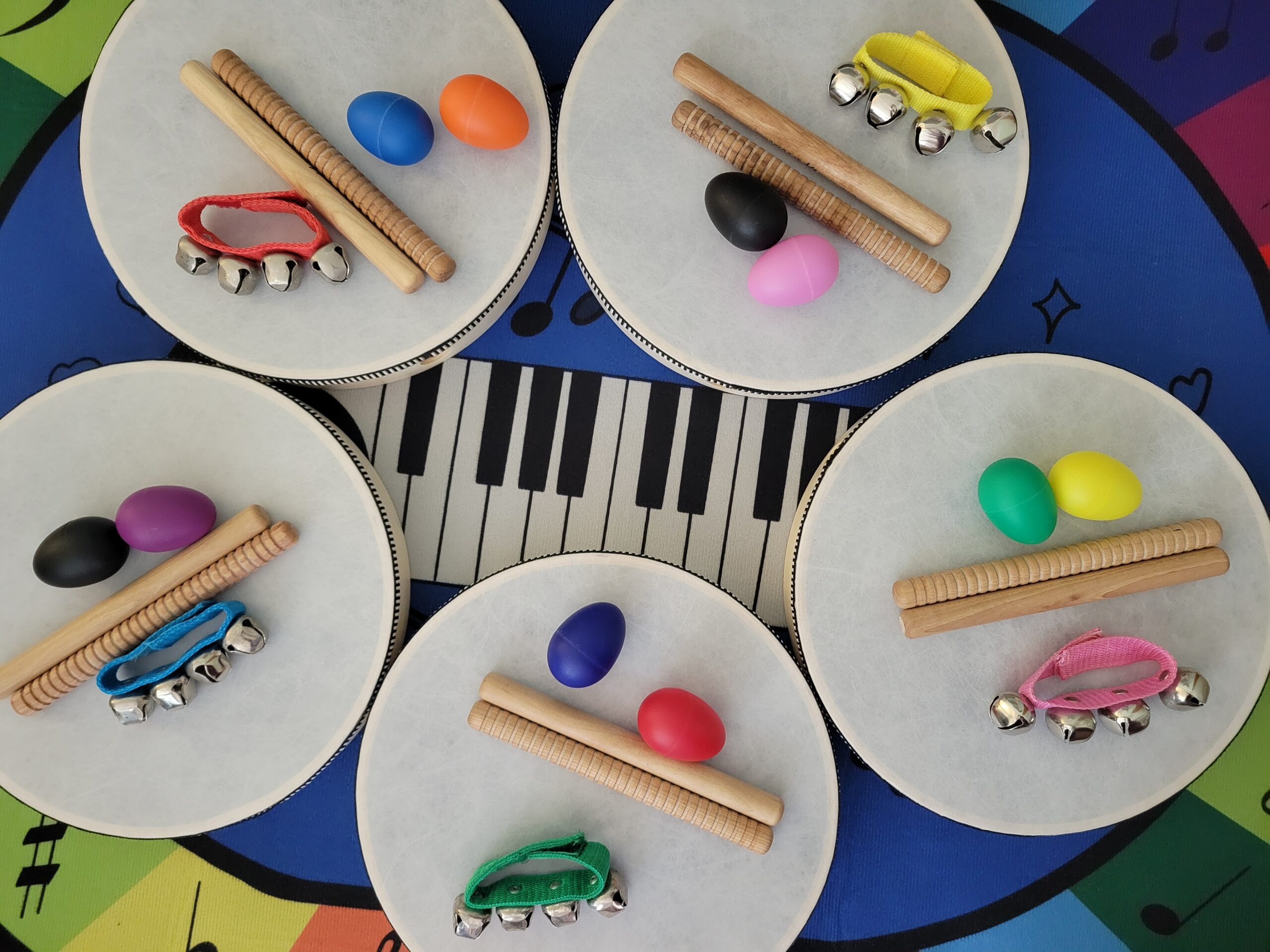
- shaking egg shakers
- tapping rhythm sticks
- singing repetitive songs
…all help children build real music skills.
Focus on STEADY BEAT First
Young children naturally respond to the beat of music and often start moving to it before they can even speak or sing. Establishing a strong sense of feeling the beat of music is the foundation for eventually adding rhythms and other musical elements. Or, as I like to call them, the ingredients that bake a delicious music cake! The STEADY BEAT is the mixing bowl that holds all of the ingredients together!
Try simple activities like:
- freeze dance
- clapping rhythms
- marching to a beat
- echoing simple patterns
- playing drums or shakers
These activities help children develop steady beat, listening skills, coordination, and confidence.
Here are a handful of music suggestions from different genres that make picking out the steady beat a breeze!
Steady Beat Stars:
- St. Louis March – Glenn Miller (almost any march works well!)
- Hoe-Down from Rodeo – Aaron Copland
- Happy – Pharrell Williams
- Brandenburg Concerto No. 3 – Johann Sebastian Bach
- Oye Como Va– Santana
Obviously, there are a bajillion more out there for you to choose from. This is just a small variety sampling. I’m a HUGE fan of providing children with the opportunity to listen to a variety of music to build appreciation.
👉Find out How to Encourage Music Appreciation in Kiddos
Teach Real Music Vocabulary
Preschoolers are capable of learning real music concepts when they’re taught in the right way–through movement, instruments, repetition and play. Music is a language. Early childhood is the best phase of life in which to learn an additional language. Why would we NOT teach the REAL music vocabulary? They’re so capable of learning it!
These are the definitions that I use. EVERY SINGLE TIME I use one of these words, I have them call and respond/echo the word and then the definition (phrase by phrase).
- Tempo: tells us “How fast or slow does the beat go”
- Pitch: tells us, “Where does the note go? Does it go high? Does it go low? Does it stay right in the middle? OR go anywhere in-between?” (We always pair this with singing high, low, middle and with hand movement for the body-brain connection.)
- Forte: “Loud”
- Pianissimo: “Very, very quiet.”
- Presto: “Super-duper stinkin’ fast.”
- Largo: “Very slow.” (Sung slowly and with slow moving arms.)
- *Rhythm: “Patterns of sound on a steady beat.” (This one is definitely trickier and not used as often.)
👉Find out How I Teach the Language
Repetition Helps Children Learn
If your child wants the same song or story over and over again, that’s actually a good thing! (Even if it might get old for you.)
Recognizable Melodies
In listening to a familiar song, the repetition helps young children build confidence, strengthen memory, and recognize musical patterns. “Piggyback Songs” provide an added bonus, and they are incredibly powerful for preschool music learning. Singing our Sea Creatures version of The Wheels on the Bus, (a melody kiddos probably already know), for example, allows their brains to more quickly learn the new words and feel more confident as a singer by knowing what pitches to sing.
Making Music Easy for Parents and Teachers
Whether you’re a parent, homeschooler, preschool teacher, or daycare provider, music does not have to feel intimidating!
You don’t need formal music training. You simply need playful, joyful opportunities to explore music together.
This is what we do in Little Kiddos Music™ classes! Each class is designed to be playful, evidence-based, and engaging without the chaotic pacing so often found in children’s programming. A lot of the ‘music education videos’ for little ones are not only overly stimulating and don’t teach actual music vocabulary and theory.
Little Kiddos Music also provides you with the easiest possible way to teach music to ages 1-6. Through playful, engaging video classes, kiddos feel like they’re in the classroom with me, Ms. Jenny! The videos are designed to be lower-stimulation with moments of color and simple graphics to encourage focus and participation. Little Kiddos Music is an expert-led music program designed specifically for toddlers and preschoolers to learn through singing, movement, storytelling, and hands-on instrument play.
👉 Find out what instruments are the best for preschoolers!
Find out what makes Little Kiddos Music different (in the best possible way)!
👉Why Little Kiddos Music?
Just press play and let the learning begin!
👉 Little Kiddos Music video curriculum