Music Supports Early STEM — especially in Preschool and Kindergarten

When most people hear the word STEM, they think of coding, robotics, engineering projects, or science experiments.
But for infants, toddlers, and preschoolers, STEM learning looks very different.
Long before children build a robot or write a line of code, they are learning to recognize patterns, make predictions, solve problems, classify information, and understand cause and effect. These foundational skills begin developing in everyday play experiences — and one of the richest opportunities for building them may be something many people overlook:
Music!
Music Is Full of Patterns
At its core, music is built on patterns.
I also like to say that music is a language. And what is language? Different combinations and patterns of sound assembled to have meaning.
In music, without even always realizing it, young children learn to recognize repeating rhythms, melodies, movements, and song structures. They begin to anticipate what comes next and notice similarities and differences.
These early patterning skills are significant because pattern recognition is a key building block for later mathematical thinking.
When a child claps a rhythm, echoes a pattern, or notices that a song repeats, they are engaging their brains in ways that support future learning far beyond music class.
Music Builds Early Math Skills
Many early childhood educators are surprised to learn how naturally music supports mathematical thinking.
Children experience counting when they sing number songs. They compare fast and slow tempos. They explore concepts such as more and less, sequencing, matching, sorting, and spatial awareness through movement activities.
Rhythm itself is mathematical. In fact, nearly every single time that I say the word, “rhythm,” in Little Kiddos Music classes, I have the kiddos echo: “Patterns of sound. (Patterns of sound.) On a steady beat. (On a steady beat.)”
Looking at some of our rhythms (especially whole notes and half notes) is the perfect way to teach early division and fractions!
If that isn’t math, I don’t know what is!
In every class, we play “Rockin’ Rhythms” —four measures of four beats with different rhythms. Occasionally, we use the real rhythm notation (images) — as seen in this clip. Most of the time, we use more kid-friendly images, such as:
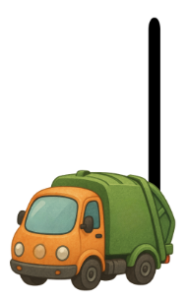
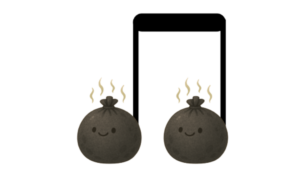
Not only does this boost pattern-recognition and early math skills, but it assists in language and early literacy, as well.
Ahh, the massive power of little kiddos music!
Whether children are keeping a steady beat, following rhythmic patterns, or moving to music, they are practicing important skills that help lay the foundation for later numeracy development.
And perhaps most importantly, they’re doing it through joyful, active participation!
I didn’t benefit from in-depth music education as a young child, and I’ve often wondered about the cause and effect as I, personally, have struggled to make peace with math. In fact, I had to practice a growth-mindset when getting my Masters in Education. I was going to have to teach math?! Gasp! The horror!
When I was teaching elementary music, I shared with my students that it was music-math and math-in-music that helped me accept math more as a friend than enemy. (To be completely honest, sometimes adulting-math still feels a bit more like a frenemy! We continue to work on our relationship though.)
Music Teaches Cause and Effect
Young children are natural scientists.
They are constantly asking questions, testing ideas, and observing results. If you’ve ever been around little ones you’ve heard the repeated chorus of preferred questions: “Why? How come? What’s that?!”
Music provides endless opportunities for this type of exploration:
What happens when I shake the instrument harder?
How does the sound change if I tap softly instead?
How can we make the music louder without going faster?
What happens when we speed up the beat? (In Little Kiddos Music classes, we use our magic-music wand, our music-magic wand, and say the magic word: Accelerando!)
Through these experiences, children learn that their actions create predictable outcomes — a fundamental scientific concept known as cause and effect.
Music Strengthens Executive Function Skills
Executive function skills help children focus attention, remember directions, control impulses, and shift between tasks.
These skills are strongly linked to school readiness and long-term academic success.
Music naturally exercises these abilities.
Children listen carefully for cues, stop and start with the music, remember movement sequences, follow multi-step directions, and adjust their actions based on what they hear.
Every time a child freezes during a movement song or changes from a fast beat to a slow beat, they are practicing self-regulation and cognitive flexibility.
We use fine and gross motor skills constantly — controlling how we play our rhythm sticks, using our bodies as we dance, move and groove.
Even crossing the mid-line by tapping egg shakers across our bodies on our shoulders. All of these seemingly simple and fun acts have massive impacts on brain development.
Music Makes Learning Social and Joyful
One reason music is such a powerful early learning tool is that children rarely experience it as “work.”
Music invites movement, participation, laughter, and connection.
We have so much silly fun, for crying out loud! I very often amuse myself with the ridiculous shenanigans we get to experience in early childhood music!
Children sing together, move together, take turns, listen to one another, and celebrate success together.
These positive experiences help build confidence and create a strong foundation for future learning.
When children associate learning with joy and curiosity, they are more likely to remain engaged and motivated as they grow. And, THAT is music to everyone’s ears!
Supporting the Whole Child
As educators and families work to prepare children for future success, it’s time to broaden our understanding of what early STEM learning can look like.
Music education is often viewed as an optional, enrichment activity and is often not a feasible or financial option for education centers, daycares, preschools or families. But its impact reaches far beyond musical skills.
This is just one of the many reasons I created the video curriculum for Little Kiddos Music Academy. The benefits of early childhood music are so broad and beneficial; it shouldn’t be limited to just a lucky few.
Families, teachers an daycare owners and entire preschools can access this STEM-boosting, music-building, joy-filled resource.
Through singing, movement, rhythm, storytelling, and instrument play, children develop language and literacy skills, mathematical thinking, motor coordination, self-regulation, social-emotional skills, and creative problem-solving.
Music serves as a bridge that connects multiple areas of development at once. Young children should have opportunities to practice these skills every day.
For young children, learning does not happen in isolated subjects. It happens through meaningful, integrated experiences that engage the whole child. (And perhaps most important of all, are fun!) So, while it may look like we’re just rockin’ out and having loads of fun in Little Kiddos Music…we are! And yet, there’s even more magic happening beneath the surface, too!